
Commercial Glass Dryer: The Best Options for Pubs, Bars & Hospitality Venues
A commercial glass dryer can help pubs, bars and hospitality venues get clean glasses back into service faster without relying on hand drying. This guide explains when a dryer is worth buying, what to look for in rack compatibility, positioning and running costs, and how to choose between the DriPOD 400 and 500 for your existing glasswasher setup.
Commercial Glass Dryer Buying Guide
See When Drying Is Holding Up Service, What to Check Before Buying and How a Dryer Could Fit Your Existing Glasswasher Setup
If clean glasses are regularly coming out of the glasswasher faster than they can dry, the problem soon shows up elsewhere.
Racks sit waiting, staff reach for a cloth because another pint glass is needed now, or more glassware has to stay in circulation simply to cover the gap.
That is usually the point where a commercial glass dryer starts to look worth investigating.
The practical question is whether a dryer will work with the glasswasher racks you already use and make enough difference during a busy service to justify the space it takes up.
Drying speed matters, but it is not the only thing worth comparing.
For some venues, air drying is perfectly adequate. For others, drying is the slowest part of getting clean glasses back behind the bar.
When Do You Need a Commercial Glass Dryer?
Use Wet Racks, Hand Drying and Glass Turnaround to See Whether Drying Is the Part Holding Up Service
Venue size alone does not tell you whether you need one.
What matters is where clean glasses stop moving once they come out of the glasswasher.
| What You Notice During Service | What It Could Mean | What To Look For In A Better Setup | How DriPOD Addresses It |
|---|---|---|---|
| Wet racks are stacking up beside the glasswasher | Washing may be keeping pace, but drying is holding glasses up before they can go back into use | A way to move full racks through drying without waiting for them to air dry | DriPOD works with commercial glasswasher racks, with models for racks up to 400mm and 500mm |
| Staff reach for a cloth when glasses are needed quickly | Your team is stepping in because the normal drying process cannot keep up during busy periods | A setup that gets glasses dry without needing someone to dry them by hand | Simple on/off operation means staff can use the dryer without setting timers or adjusting drying programmes |
| You keep more glassware in circulation because clean glasses are still wet | The issue may be turnaround between washing and reuse rather than the number of glasses you own | A way to get clean glasses back into use sooner | Forced ambient airflow gives wet racks a dedicated drying stage before the glasses return to service |
| You do not want installation work around the wash area | Any new equipment needs to work with the space and power supply already there | Check the rack size, position and power requirement before choosing a machine | DriPOD 400 and 500 models use a standard 13A plug, making it easier to add DriPOD to an existing setup |
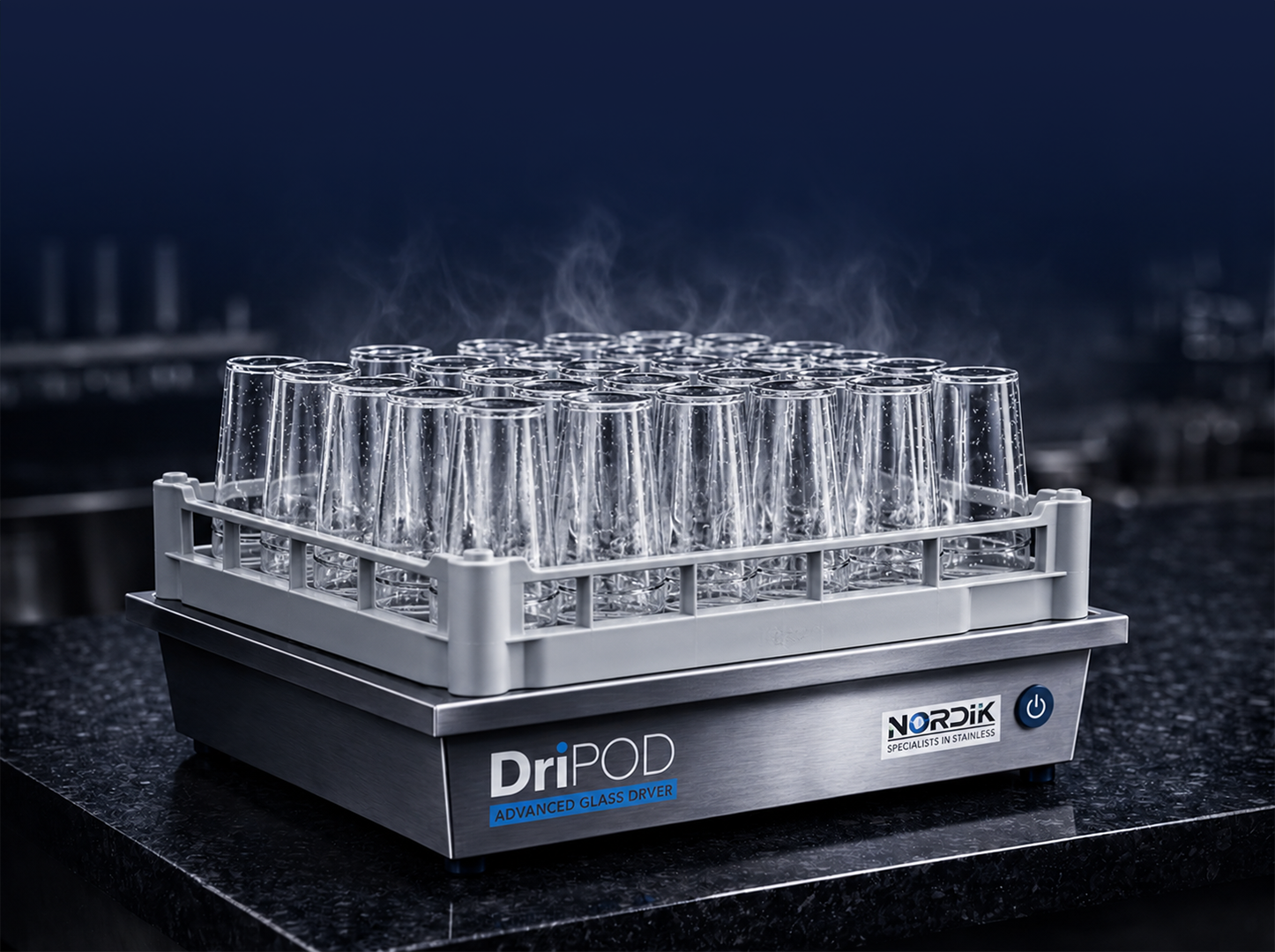
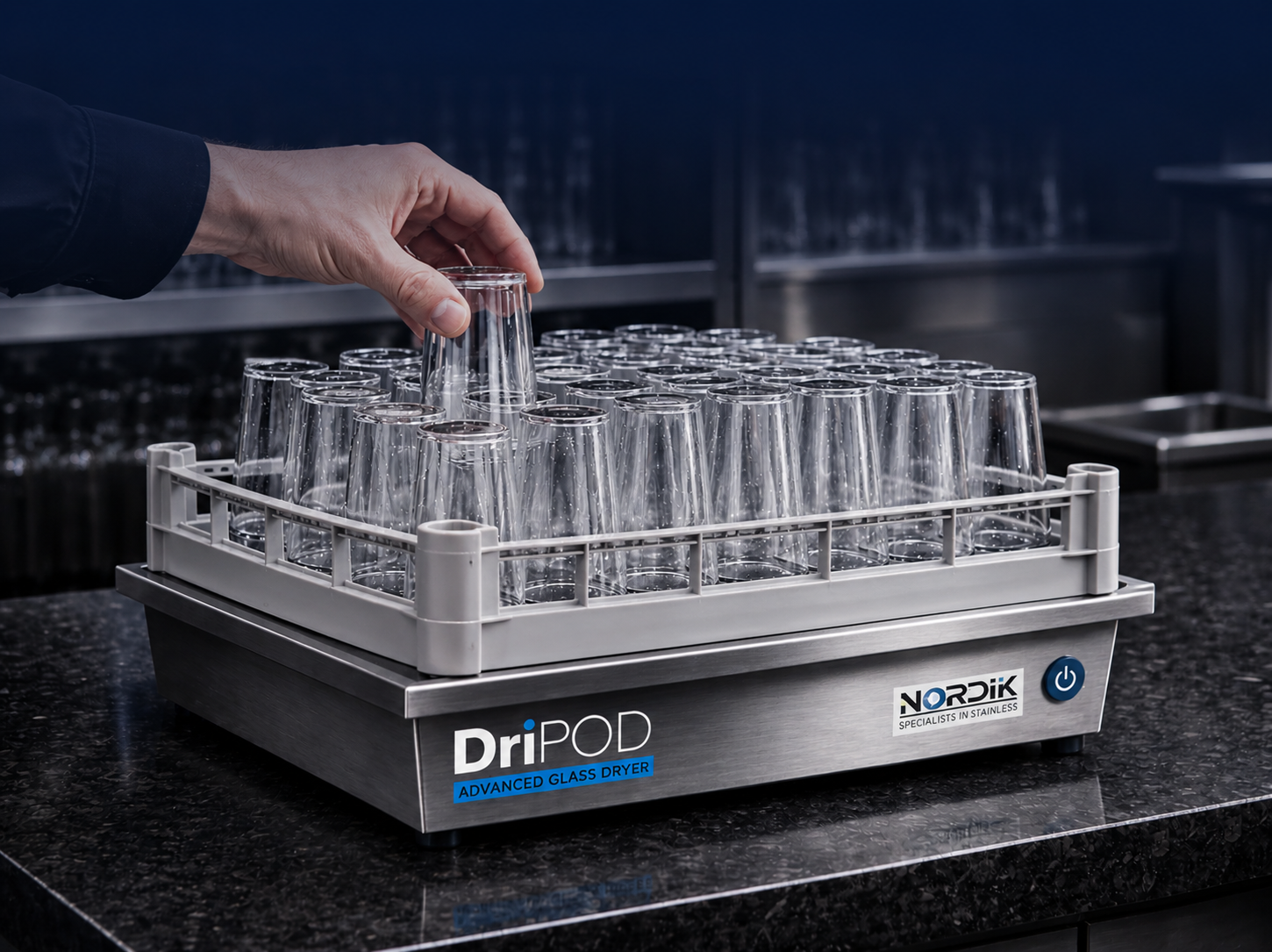
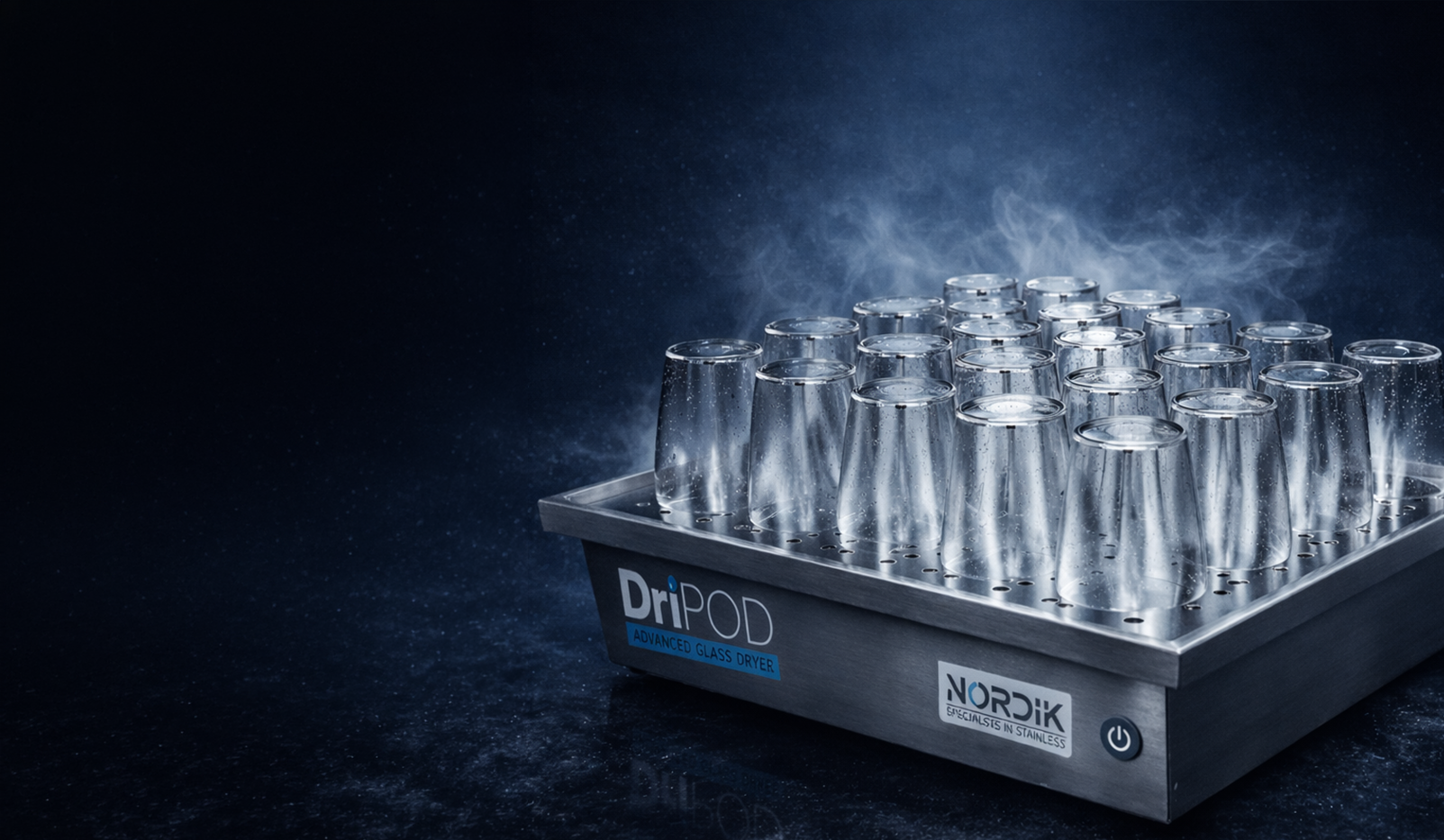
The washed rack goes onto DriPOD, where airflow dries the glasses while your team gets on with service. Staff still move the racks, but they do not need to dry each glass by hand.
What to Look for in a Commercial Glass Dryer
Choose a Dryer That Fits Your Racks, Wash Area and the Way Staff Work During Service
Choosing the right commercial glass dryer begins with checking the rack size used by your existing glasswasher.
A glass dryer that cannot accommodate the racks already moving through the venue creates more work rather than removing it.
Where the dryer sits matters just as much.
Think about the route a rack takes from the glasswasher, through drying and back towards the service area.
A dryer can be compact and still be badly positioned if staff have to double back or move racks across a busy walkway.
More controls are not always a benefit in a busy venue.
If staff simply need to switch the dryer on when it is required, extra timers and settings can become one more thing to manage during service.
Are Commercial Glass Dryers Worth It?
Use Your Busiest Service Period to See Whether Faster Glass Turnaround Would Make a Real Difference
The purchase becomes easier to justify when staff regularly stop other jobs to dry glasses, or washed racks sit waiting while the bar needs them.
That is work being repeated throughout a busy shift.
During your next busy service, note how often someone reaches for a cloth and whether clean glasses are waiting to dry when they are needed.
Those observations give you something concrete to weigh against the purchase price and running costs.
If you're comparing different systems, our
Airack vs DriPOD comparison looks at the features, controls and construction of both options.
DriPOD 400 vs DriPOD 500 Commercial Glass Dryers
Choose the Model Around Your Rack Size, Available Counter Space and How Much Glassware You Need to Move
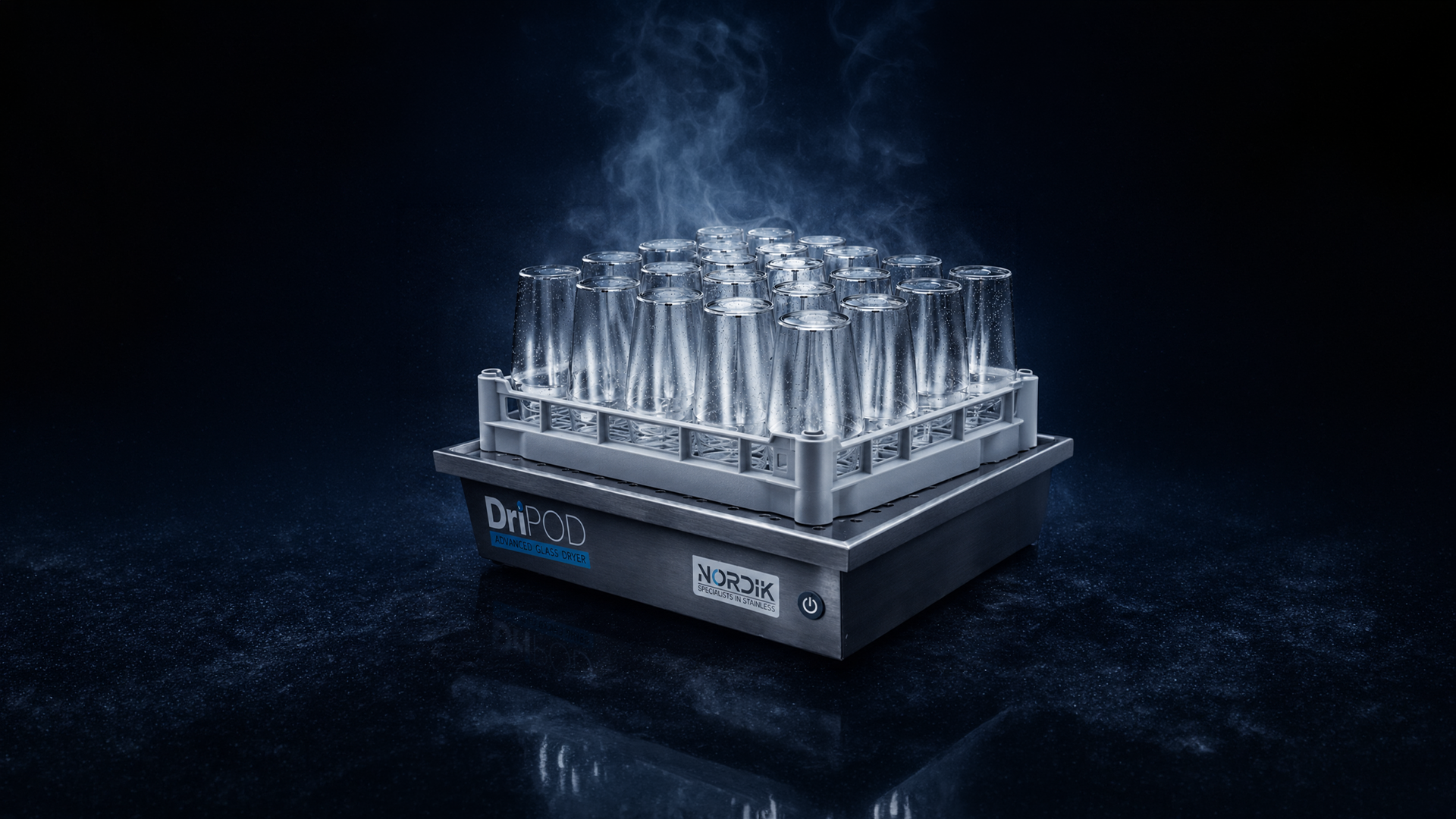
DriPOD 400 takes racks up to 400mm and uses a single 115W fan.
It measures 220mm high × 455mm wide × 455mm deep and weighs 8.9kg.
That makes it the more compact option for venues using smaller baskets, particularly where counter space is limited.
DriPOD 500 takes racks up to 500mm, including 450mm baskets, and uses twin fans with a 230W connected load. It measures 220mm high × 556mm wide × 556mm deep and weighs 12.4kg.
The larger capacity makes it better suited to venues using bigger racks or moving a higher volume of glassware during service.
The larger machine is not necessarily the better choice.
Match the dryer to the basket size you already use and the space available around the glasswasher rather than buying extra capacity you do not need.
Explore the DriPOD 400 and DriPOD 500 to see how each model could fit into your glasswashing setup.
Why Choose DriPOD?
Choose a Dryer From a Manufacturer Used to Building Stainless-Steel Equipment for Busy Commercial Catering Environments
A glass dryer needs to cope with regular use beside your glasswasher.
Knowing who makes it, and what else they manufacture, gives you something concrete to assess alongside drying speed.
DriPOD is made by Nordik, a British manufacturer of stainless-steel commercial kitchen equipment. Its wider manufacturing work includes equipment for commercial washing and preparation areas.
- More than 30 years of commercial kitchen equipment experience → the business behind DriPOD has an established background in making equipment for catering environments. That experience belongs to Nordik’s wider manufacturing business, not to the DriPOD range alone.
- In-house fabrication of catering sinks, dishwasher tables and other stainless-steel equipment → Nordik’s work includes the wash areas where a glass dryer will be used, making its manufacturing background directly relevant to your purchase.
DriPOD itself has a
304 stainless-steel exterior designed for wet commercial environments, giving you a specific construction detail to compare when choosing equipment for the space beside your glasswasher.
Commercial Glass Dryer FAQs
Know What It Costs to Run and What Day-to-Day Use Involves Before You Buy
Drying time varies with the glassware and how full the rack is, but a basket of pint glasses can typically be dry within a few minutes.
DriPOD uses continuous ambient airflow rather than a fixed timed cycle, so the operator switches it off once the glassware is dry.
DriPOD is designed for a wide range of hospitality glassware, from pint glasses to stemware.
The glasses remain in the glasswasher rack while they dry, so the important point is that they are supported securely and positioned so the airflow can reach the wet surfaces.
The DriPOD 400 has a connected load of 115W, while the larger DriPOD 500 is rated at 230W.
If either machine ran continuously for one hour at its rated load, that equates to approximately 0.115 kWh for the 400 or 0.23 kWh for the 500.
Multiply that figure by your venue’s electricity price per kWh to estimate the cost for an hour of continuous use.
Dripod is designed to integrate into existing bar and service environments without requiring layout changes. Its compact footprint means it can be positioned where it adds the most value without getting in the way.
Routine cleaning is straightforward.
During daily cleaning, wipe the perforated lid and the area beneath it with a dry cloth to remove any small amount of water that has collected.
The stainless-steel exterior can then be kept clean as part of the normal cleaning routine around the glasswashing area.
Using a commercial glass dryer removes the need to put a drying cloth on every clean glass.
That reduces extra handling after the glasswashing cycle and avoids relying on a cloth that may become damp during service.
The dryer itself does not wash or sanitise the glassware, so correct glasswasher operation and normal hygiene procedures still matter.
A glass dryer removes moisture, so glasses should not need to be dried by hand afterwards.
Drying and polishing are different jobs, though.
A dryer will not remove residue, water marks or other problems already left by the washing process.
If clean glasses regularly come out marked, the glasswasher, water quality or wash process may need attention rather than the drying stage.
Commercial Glass Dryer Sizing and Setup
Get Clean Glassware Back Into Service With Less Hand Drying Behind the Bar
When the next round is waiting, you need clean glasses ready to use without pulling someone away to dry them.
If that is happening regularly in your venue, the next step is to check which DriPOD fits beside your glasswasher.
Send the DriPOD team your glasswasher basket size and the counter space available.
Describe what happens during your busiest service so you can discuss where the dryer would sit and how your team would use it.
DriPOD offers practical advice around your existing setup before you commit.
Order Yours Now opens an enquiry form. Use it to talk through the model you need and ask for current pricing before placing an order.
Find The Right DriPOD For Your Venue
If wet racks are slowing service, tell us your basket size and available space. We’ll help you choose the DriPOD model that fits your glasswashing setup.